Hydraulic cylinders are among the most widely used components in industrial hydraulic systems. They are employed in automated machinery, presses, material handling systems, industrial vehicles, lifting equipment, and many other contexts where it is necessary to convert hydraulic energy into linear motion.
Despite their apparent simplicity, hydraulic cylinders require careful selection during the design phase. A cylinder that is improperly sized or unsuitable for the application can compromise system performance, reduce motion precision, and generate anomalies over time.
What is a hydraulic cylinder
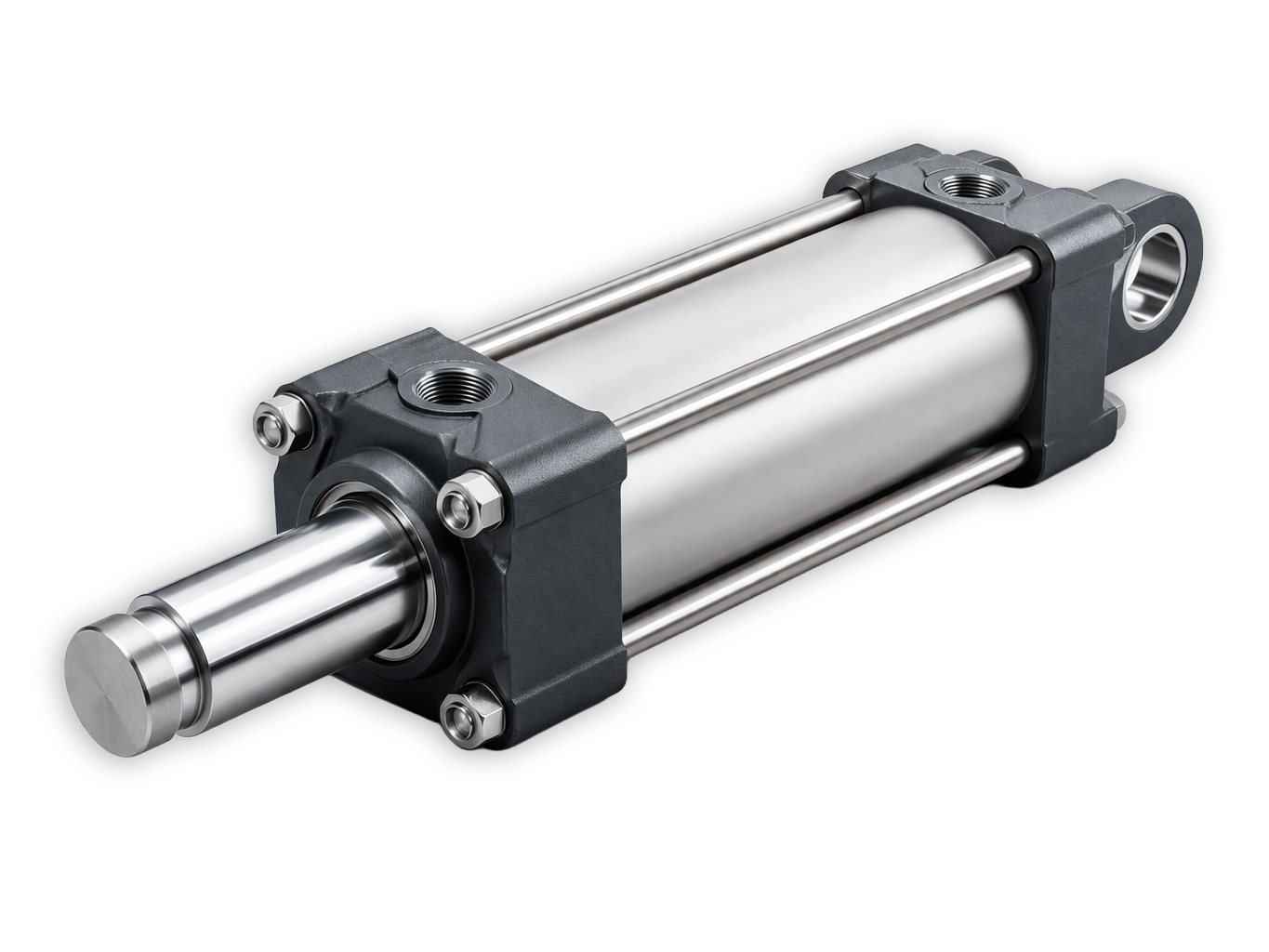
A hydraulic cylinder is a linear actuator that converts hydraulic fluid pressure into force and movement. It consists of a cylindrical body inside which a plunger or piston connected to a rod slides. Pressurized fluid enters the cylinder chamber, pushes the piston, and generates the required linear motion.
In the most common configuration, the cylinder is double-acting: it can be actuated in both directions — extension and retraction — through two fluid ports. There are also single-acting cylinders, where return is achieved by gravity or a spring force.
How a hydraulic cylinder works
The operating principle is straightforward. When fluid enters the thrust chamber, pressure exerts a force on the piston proportional to the cross-sectional area. This generates the pushing force — or pulling force during retraction.
The fundamental relationship is simple:
Force = Pressure × Area
The available force depends on system pressure and piston size. The speed of movement depends on the fluid flow rate. Knowing these parameters is fundamental to designing an effective system: an oversized cylinder wastes resources, an undersized one cannot do the required work.
Main types of hydraulic cylinders
Double-acting cylinders
Double-acting cylinders are the most common type. They allow controlled motion in both extension and retraction by sending pressurized fluid to either side of the piston. They are suited to the vast majority of industrial applications where controlled force is required in both directions.
Single-acting cylinders
Single-acting cylinders have only one fluid port. The active stroke is in one direction only; return occurs via an internal spring or gravitational force. They are simpler solutions used in applications where the return stroke does not require controlled force.
Telescopic cylinders
Telescopic cylinders consist of multiple nested stages and allow very long strokes in compact dimensions. They are typically used in industrial vehicles, tipping systems, and applications where space is limited but a high range of travel is needed.
Differential cylinders
Differential cylinders exploit the difference in area between the two piston chambers to achieve a higher extension speed than retraction speed, without increasing pump flow rate. They are used in applications where a specific phase of the cycle needs to be accelerated.
Cylinders with integrated guide
Some cylinders include integrated lateral guides to absorb transverse loads that would otherwise damage the rod. They are suited for applications with insufficient external guiding or with loads not centered on the cylinder axis.
How to choose the right hydraulic cylinder
Correct selection requires precisely defining the application parameters. Here are the main aspects to evaluate.
Required force
The first parameter is the required force, which determines the piston diameter based on the available system pressure. It is essential to consider both push and pull force, since the areas of the two chambers differ.
Stroke
The stroke is the distance the cylinder rod must travel. It must be defined with precision: a cylinder with an excessive stroke is more prone to rod bending and seal problems. An incorrectly calculated stroke is one of the most common causes of early failure.
Speed of movement
Extension and retraction speed is determined by fluid flow rate. If different speeds are required in the two phases, appropriate flow control valves must be specified. Underestimating this aspect can generate abrupt or uncontrolled motion.
Mounting conditions and transverse loads
The cylinder must be mounted so that loads are applied axially. If lateral loads are present, guided cylinders or adequate external guides must be used. Bending loads on the rod can cause premature seal wear and cylinder damage.
Harsh environments
In dusty, humid or corrosive environments, the cylinder must feature specific provisions: chrome-plated or stainless steel rod, reinforced wipers, appropriate paint finish or special surface treatments.
Maintenance and service life of hydraulic cylinders
A well-designed and properly maintained hydraulic cylinder can have a very long service life. The main issues that shorten it are:
– seal leaks caused by seal wear, rod damage or fluid contamination
– bearing wear from unmanaged lateral loads
– rod corrosion in aggressive environments
– mechanical damage from impact or incorrect installation
Regular maintenance — including seal inspection, rod cleaning and fluid quality checks — prevents most anomalies and extends the component’s service life.
Standard or custom hydraulic cylinders
For standard applications, a wide range of catalogue cylinders is available. However, many industrial applications require custom-designed hydraulic cylinders: special dimensions, custom stroke, specific ports, particular materials, or application-specific protection.
A custom cylinder allows optimization of system performance, reduction of footprint, and perfect integration with the machine or plant. In many industrial contexts, this is the choice that makes the real difference in terms of reliability and operational continuity.
CMH designs and supplies hydraulic cylinders for all types of applications, both from catalogue and custom-built, with the technical capability to support customers at every stage: from type and size selection, to circuit integration and after-sales support.
written by Filippo and published on 13 April 2026 at 23:30